
Technical lab · Foundation in development
Elara
A local runtime in development, designed around actual hardware capabilities.
- Rust
- Tauri
- React
- SQLite
- Linux
Challenge
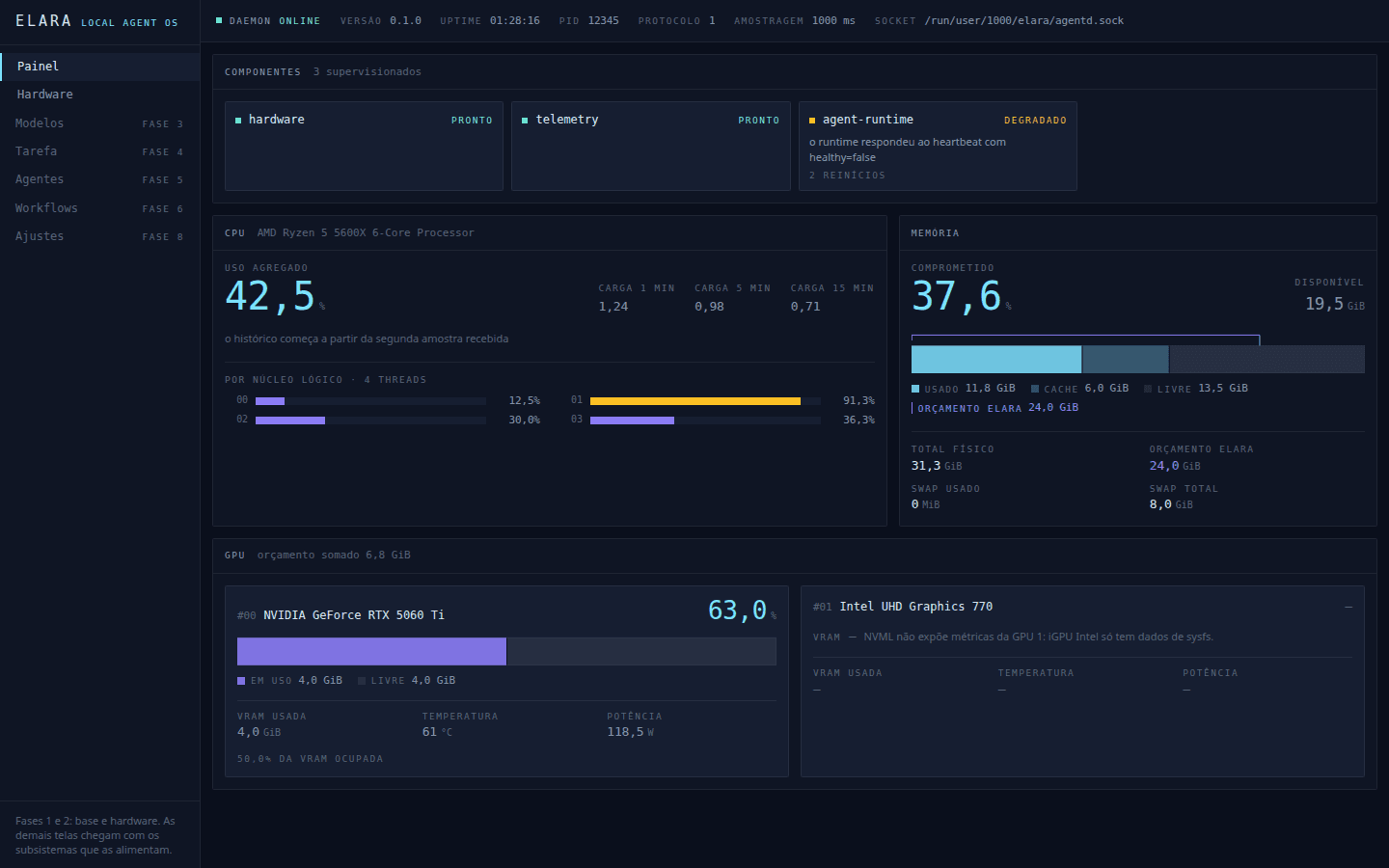
Measure actual CPU, RAM, and GPU limits before proposing local AI execution.
My contribution
Experimental project: foundation and hardware profiling are documented; inference and agent execution have not yet been implemented.
Architecture and approach
The foundation separates the Rust agentd daemon, React/Tauri interface, and a supervisable Node.js runtime. The daemon maintains SQLite state, coordinates hardware probes, and publishes events; clients use HTTP/SSE over a local Unix socket.
What was implemented
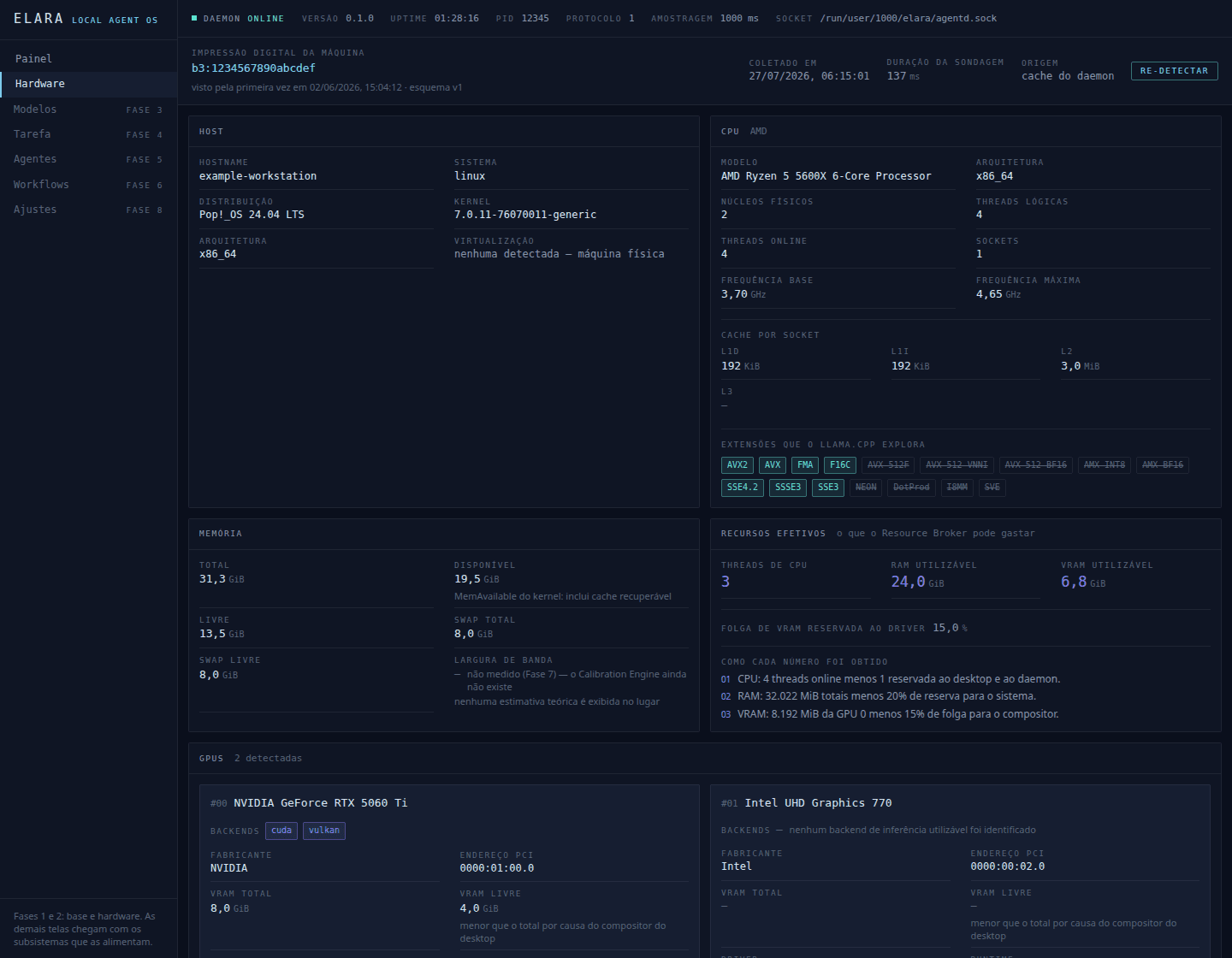
- Probes record CPU topology and resources, memory, GPUs, storage, NUMA, and cgroup limits, explicitly marking unavailable measurements.
- The daemon versions its communication contract and persists hardware facts and events independently of the window's lifecycle.
- The SDK uses Rust-generated TypeScript types and Zod validation at the IPC boundary.
- The Node.js runtime can register, send heartbeats, and be supervised by the daemon; the interface presents a dashboard and hardware profile.
Trade-offs and decisions
- The Unix socket uses filesystem permissions and keeps IPC local, but this is a Linux-first design rather than a portable remote service.
- Separating daemon, runtime, and presentation improves testability and process independence at the cost of coordinating contract evolution.
- Unknown resources remain unknown; consumers must handle partial profiles rather than assume values.
Validation and current status
Elara Local documents 224 validated Rust hardware tests and 114 TypeScript tests, plus a TypeScript build. The real frontend was captured using synthetic IPC fixtures. Tauri packaging and a live desktop-to-daemon session were not verified; model catalog, inference, and agents remain on the roadmap.
Engineering decisions
- 01
Measure before planning
Unknown resources remain unspecified instead of inventing estimates.
- 02
Local IPC
Unix sockets and Rust/TypeScript contracts define communication between the daemon and the interface.
- 03
Persistence and telemetry
SQLite, structured logging, and events enable tracking of local state.
Evidence and limitations
Public edition with reviewed demo data, 224 validated Rust hardware tests, and 114 validated TypeScript tests. The TypeScript build was validated; packaging and GUI were not verified. Inference and agents are not yet implemented.
More project screenshots
Public references
Let's build something like this.
Tell me about your problem and we'll evaluate the best approach.
Get a quote